

Target for Tonight (1941)
This 48 min film is a description of a Bomber Command raid on Germany, showing the general preparations beforehand, the raid itself from the viewpoint of "F For Freddie" and the mounting anxiety at the station when the plane, a Wellington, fails to return on time.
Douglas Boston Bomber
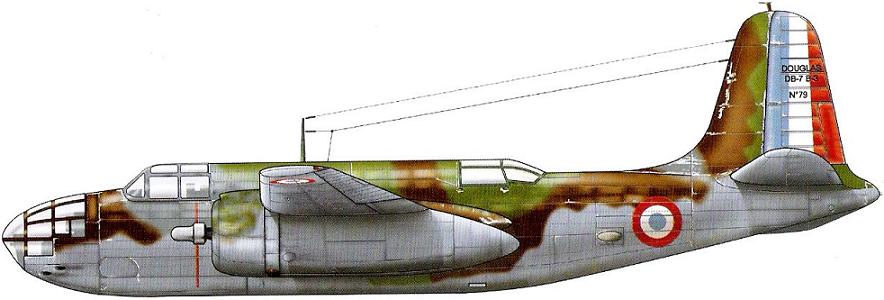
The Douglas Boston aircraft (DB7) was a highly effective light bomber/light attack aircraft. It was powered by a pair of Wright Cyclone 2600 supercharged engines developing 1600 horsepower. These gave the Boston an impressive top speed of 260 knots.
The Douglas DB-7 served primarily with Soviet, US and British air forces.
The DB-7 was also used by Australian, South African, French and Dutch services during the War, and Brazil afterwards. The aircraft was known as the "Boston" among Commonwealth air forces, while the night fighter variants were known as the "Havoc". The USAAF assigned the DB-7 the designation "A-20" and gave it the popular name "Havoc," adopted from the RAF moniker.

Plane Type: Bomber
Manufacturer: Douglas Aircraft Company
Introduced: January 10,1941
Primary users: Soviet Air Force, United States Army Air Corp, Royal Air Force
Number built: 7,478
Performance:
Maximum speed: 338 mph (294 knots, 544 km/h) at 12,500 ft (3,800 m)
Range: 1,050 mi (912 nm, 1,690 km)
Service ceiling: 27,600 ft (8,400 m)
Rate of climb: 2,000 ft/min (10.2 m/s)
The Douglas DB-7 served primarily with Soviet, US and British air forces.
The DB-7 was also used by Australian, South African, French and Dutch services during the War, and Brazil afterwards. The aircraft was known as the "Boston" among Commonwealth air forces, while the night fighter variants were known as the "Havoc". The USAAF assigned the DB-7 the designation "A-20" and gave it the popular name "Havoc," adopted from the RAF moniker.
Plane Type: Bomber
Manufacturer: Douglas Aircraft Company
Introduced: January 10,1941
Primary users: Soviet Air Force, United States Army Air Corp, Royal Air Force
Number built: 7,478
Performance:
Maximum speed: 338 mph (294 knots, 544 km/h) at 12,500 ft (3,800 m)
Range: 1,050 mi (912 nm, 1,690 km)
Service ceiling: 27,600 ft (8,400 m)
Rate of climb: 2,000 ft/min (10.2 m/s)
1941 Conquering Crete in 10 Days
Color footage about the battle of Crete
Unternehmen-Merkur 1 of 2 (operation Mercury 1 of 2)
Unternehmen-Merkur 2 of 2 (operation Mercury 2 of 2)
Unternehmen-Merkur 1 of 2 (operation Mercury 1 of 2)
Unternehmen-Merkur 2 of 2 (operation Mercury 2 of 2)
1943 The Low-Altitude Bombing of the Ploesti Oil Fields
Montage of Allied and German rarely seen color footage.
Sunday, Aug. 1, 1943. The Low-Altitude (to avoid German advanced Radar equipped line of defence) bombing of the Ploesti Oil Fields was deemed a success, even though 54 of the 177 bombers that took part were lost, and 53 more were heavily damaged. The refineries output was greatly curtailed, and five Medals of Honor were awarded, the most for any single American military action.
Soundtrack added (Demo Only) in 2008 by ROMANO-ARCHIVES, performed by Introspective (Vanishing Point - Black Mesa Winds).
The Lancaster
The Avro Lancaster was a British four-engine Second World War bomber aircraft made initially by Avro for the British Royal Air Force (RAF). It first saw active service in 1942, and together with the Handley-Page Halifax it was one of the main heavy bombers of the RAF, the Royal Canadian Air Force and squadrons from other Commonwealth and European countries serving with RAF Bomber Command. The "Lanc" or "Lankie," as it became affectionately known, became the most famous and most successful of the Second World War night bombers, "delivering 608,612 tons of bombs in 156,000 sorties. Although the Lancaster was primarily a night bomber, it excelled in many other roles including daylight precision bombing, and gained worldwide renown as the "Dam Buster" used in the 1943 Operation Chastise raids on Germany's Ruhr Valley dams.
Subscribe to:
Posts (Atom)
